
Read this beside Ursula Le Guin’s The Dispossessed, and you will see the two directions American science fiction could have gone in the 1970s and chose both. Heinlein published Time Enough For Love in 1973. Le Guin published The Dispossessed in 1974. They are the two most ambitious science fiction novels of their decade by writers who were arguing with each other through their books without either one acknowledging the argument.
Heinlein’s novel is the life story of Lazarus Long — a man born in 1912 who has, through a combination of selective breeding and medical longevity treatments, lived to be well over two thousand years old. The book is a frame narrative. Lazarus is being interviewed by a succession of historians and family members and lovers who want his life on record before he finally, voluntarily, lets himself die. Inside the frame are a dozen long anecdotes from his past — a nineteenth-century Missouri homesteading story, a post-apocalyptic rescue story, a Jovian mining story, and a long final sequence in which Lazarus goes back in time to meet his own mother. The book is a thousand pages. It is also, by any ordinary metric of novel-writing, a mess. Heinlein abandoned the novelistic discipline he had maintained through his 1950s juveniles and his 1960s masterpieces (Starship Troopers, Stranger in a Strange Land, The Moon is a Harsh Mistress) and wrote, instead, a grab-bag of ideas, lectures, aphorisms, incest fantasies, and libertarian screeds held together by his central character’s voice.
Le Guin’s novel, published one year later, is the opposite in every architectural choice. Her Shevek is a physicist on an anarchist moon who travels to the capitalist planet his ancestors left a hundred and seventy years earlier. The book is tight. The book is symmetrical. Every chapter alternates between Shevek’s present journey and his past on Anarres. The anarchism Le Guin imagines is neither a paradise nor a hell — it is working, imperfectly, as anarchism would actually work, with real shortages and real pettinesses and real moral heroism. The book is about eight hundred pages shorter than Heinlein’s and is, by any ordinary metric of novel-writing, a masterpiece.
And yet. And yet. I have read Time Enough For Love three times. I have read The Dispossessed twice. The Heinlein stays with me more, and I am not entirely proud of this, and I want to explain why.
Heinlein’s undisciplined book contains, in its least disciplined section — the Notebooks of Lazarus Long, an interstitial chapter of aphorisms that Heinlein stuffed between two plot sections because he did not know where else to put them — some of the most quoted sentences in twentieth-century American popular philosophy. Specialization is for insects. An armed society is a polite society. Never underestimate the power of human stupidity. Never try to teach a pig to sing; it wastes your time and annoys the pig. These sentences escape the book. They circulate. They are quoted by people who have never read Heinlein and who would be startled to find out that he is their source.
Le Guin’s more disciplined book does not produce aphorisms. It produces arguments. A reader finishes The Dispossessed with a whole moral framework for thinking about anarchism, scarcity, property, and freedom. A reader finishes Time Enough For Love with a character. Heinlein put everything he knew into the voice of a single man. Le Guin put everything she knew into the structure of a whole society. The books do not compete on the same terrain.
The pairing shows you what American science fiction could have become. Heinlein is the end of the pulp tradition of the single charismatic protagonist whose voice carries the novel like a rickety cart. Le Guin is the beginning of the serious science fiction novel as political philosophy in fictional clothing. The 1970s was the one decade in which both modes were fully operational, and after 1980, the field split — the Heinlein mode went into military sci-fi and libertarian space opera, the Le Guin mode went into academic science fiction and literary crossover. The decade of the two books was the decade in which the genre could have decided to hold both. It did not. It split.
A note on the incest in Time Enough For Love. The novel’s final sequence, in which Lazarus goes back to 1916 Missouri and sleeps with his own mother, is the section most modern readers cannot forgive the book for, and I cannot fully defend it to them. Heinlein was, in 1973, openly and almost proudly working out a late-life libertarianism of the body that led him into these sexual configurations — his mother-son scene, his sister-brother scenes in Farnham’s Freehold, the group marriages in The Moon is a Harsh Mistress. He thought he was being shockingly honest about desires culture had suppressed. A fair reader will see the honesty. A fair reader will also see that the novel never asks what the women thought of these configurations, and that the thing-that-was-suppressed was suppressed for reasons Heinlein did not examine.
Le Guin was examining. The Dispossessed is the book a writer writes who has actually thought about what men and women owe each other. Heinlein, by 1973, was not thinking anymore. He was channeling. The channeling produced great aphorisms and great scenes and a terrible mother-son episode.
Read them both. Read Heinlein first. Read Le Guin second. Feel the argument the American genre could have had and refused to have. Then read whichever of the two you need more of at whatever age you are. The answer will not be the same at thirty as it is at fifty. Both are still the books.
A related vagobond.com piece: On Translation and Survival.
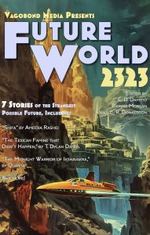
Readers and fans of Time Enough For Love will really enjoy Future World 2323 — my novel set three centuries from now, in a world that has had time enough for a few loves and not enough for others. Heinlein’s long life span, filtered through a tradition he would not have recognized. Have a look and let me know what you think.

CD Damitio writes at indignified.substack.com — essays on utopias, dystopias, and the spaces between. Free to read. No algorithm, no sponsored content. His books can be found on Amazon at https://www.amazon.com/stores/CD-Damitio/author/B001JP7NWA
CD Damitio writes INDIGNIFIED — utopias and dystopias explored. Free to read.