
Verdict first: Coleman Barks’s Rumi is the best-selling poetry in America. It is also not Rumi. Both of these things are true. The book is worth owning anyway. You should know what you are owning.
Jalal al-Din Muhammad Rumi — Mawlana, the Master — was a thirteenth-century Persian jurist, theologian, and Sufi mystic who taught at a madrasa in Konya in Anatolian Turkey and who, in his late forties, encountered a wandering dervish named Shams of Tabriz whose presence dissolved Rumi’s identity as a scholar and reconstituted it as a poet. The poetry poured out of him for twenty-five years. Forty thousand verses in the Divan-e Shams-e Tabrizi. Twenty-five thousand more in the Masnavi. The whole corpus is in Persian, with some Arabic, some Turkish, some Greek — the languages of the cosmopolitan Seljuk and Mongol court culture of Konya in the 1250s — and the poetry is embedded in a fully articulated theological system, Islamic jurisprudence, Qur’anic citation, and a cultural context without which the lines lose most of their meaning.
Coleman Barks, an American academic poet at the University of Georgia, does not read Persian. He never has. In the 1970s, the scholar Robert Bly handed him a pile of nineteenth-century English literal translations by the British Orientalist Reynold A. Nicholson and said something like these are locked in their cages, get them out. Barks did. He produced, over the following decades, English versions of Rumi that strip out the Islamic content, re-arrange the line breaks into a free-verse American idiom, and present Rumi as a kind of universal, post-religious, New Age mystic whose insights can be absorbed by any reader without engagement with Islam. This version of Rumi has sold millions of copies. It has been quoted in self-help books, wedding ceremonies, and presidential speeches. It is, in sales, the most widely read poetry in the English-speaking world.
The scholarly objection to Barks is serious and correct. Barks strips the Islam out of a poet for whom Islam was the air. He softens the erotic edges that are intensely present in the Persian original. He smooths the doctrinal specificity into a gentle universal spirituality. He has, in effect, produced an American Protestant Rumi for a readership that wanted permission to love a Muslim poet without having to accept that he was a Muslim. Fatemeh Keshavarz, Persian literature scholar at the University of Maryland, has made this case thoroughly. She is right. Barks is performing a kind of spiritual appropriation, and the appropriation matters.
The defense of Barks, which I also accept, is narrower. The Nicholson literal translations he worked from are almost unreadable. Any English Rumi available to a general American reader before Barks was either inaccurate to the tone of the original or inaccessible to the reader. Barks’s versions, whatever their scholarly deficiencies, opened the gate. A reader who reads Barks and never moves past him has read one kind of Rumi. A reader who reads Barks and then moves on to the Franklin Lewis biography and translations, or to the Jawid Mojaddedi versions of the Masnavi, or to Annemarie Schimmel’s scholarship, or eventually to the Persian itself, has a legitimate entry point that would not have existed without Barks.
This is where I stand. Own Barks. Read Barks. Read the Essential Rumi volume when you need the lines that land. Then, when you are ready, read Franklin D. Lewis’s Rumi: Past and Present, East and West, which is the definitive English-language scholarly account of Rumi in his full context, and which will show you how much Barks left out. Then read Jawid Mojaddedi’s Penguin translation of the Masnavi, Book One, which is the closest a reader without Persian can come to the thing Rumi actually wrote. You will find that Mojaddedi’s Rumi is a better poet than Barks’s Rumi. Barks gave you lines. Mojaddedi gives you the mind.
The lines in Barks will still move you. I will not argue with that. The lines I carry with me are mostly Barks’s, because I read Barks first, in my twenties, and the American Rumi was the one who entered me at the age that poetry enters a person permanently. Out beyond ideas of wrongdoing and rightdoing, there is a field. I’ll meet you there. I do not know if Rumi wrote that. The Persian is there somewhere, but Barks has done things to it that the Persian does not endorse. I will still keep the line.
The verdict: a flawed masterpiece of translation-as-appropriation. Worth owning. Not the last Rumi you should read. Do not let it be.
A related vagobond.com piece: On Translation and Survival.
The philosophy I have been drawing out from this kind of reading I call Baoism. Bao Ji — Bring Your Own. Including your own translator.
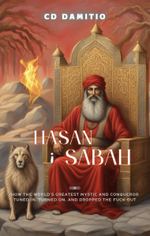
Readers and fans of The Essential Rumi will really enjoy Hasan i-Sabah and the Garden at Alamut — my novel about the Persian-speaking medieval world Rumi was born into, a hundred and fifty years before Rumi’s birth, in the same religious landscape and a harder part of it. The mysticism Rumi softened. The mysticism Barks cannot translate. Have a look and let me know what you think.

CD Damitio writes at indignified.substack.com — essays on utopias, dystopias, and the spaces between. Free to read. No algorithm, no sponsored content. His books can be found on Amazon at https://www.amazon.com/stores/CD-Damitio/author/B001JP7NWA
CD Damitio writes INDIGNIFIED — utopias and dystopias explored. Free to read.