
Dear Ursula,
You died in 2018 and I’m still writing you letters. I hope you don’t mind. You were the first novelist who ever made me feel that an imagined society could be argued with — not admired, not dismissed, argued with, the way you’d argue with a cousin at Thanksgiving about something neither of you will settle. That’s what The Dispossessed was for me the first time, and it’s still what it is.
Shevek is a physicist on Anarres — the dry, scarce moon-world colonized a hundred and seventy years before the book opens by Odonian anarchists who emigrated away from the capitalist home planet Urras. He wants to finish a theory of simultaneity. He cannot do it on Anarres because the anarchist academy, in spite of itself, has developed gatekeepers and committees and small cruelties of consensus. So he does the unthinkable. He leaves. He crosses to Urras — the beautiful, wasteful, plentiful, propertied world his ancestors rejected — and he tries to work. He does not belong there either.
You called the book an ambiguous utopia and I think a lot of readers missed how hard that word ambiguous was working. You were not writing wish-fulfillment. You were writing the thing almost no utopian writer has the nerve to write: you were showing that even the revolution grows calluses. Even the people who made the free world forget what they made it for. Even a society without money can develop a form of currency made of shame and conformity and assigned work. And even so — and this is what breaks me open every time — the book does not retreat from its own radicalism. The ending does not say the dream failed. It says: the wall is not outside, the wall is us, and the work is to keep walking through ourselves.
I think about the scene where Shevek, on Urras, is taken to a fancy restaurant and for the first time in his life he confronts the staggering abundance of a propertied society. And he doesn’t envy it. He registers it and he grieves it. You wrote that the beauty of Urras was a sickness because it existed only because other people had none. That moment is why your book is still the book I put in the hands of people who ask me what I mean when I talk about the difference between travel and tourism. You already answered it.
I’ve been reading you since 1994. I still don’t have your patience. My politics are more impatient, more scornful, more prone to kicking over the table. You would have been gentler with me than I am with myself, which was always your gift — the ability to take a person seriously without absolving them.
A few things I still wanted to ask you.
What did you think the wall was made of, finally? I’ve gone back and forth on this. Sometimes I think you meant habit. Sometimes I think you meant the fear of being alone inside one’s own freedom. Sometimes I think you meant language itself, which is why Shevek’s language, Pravic, has no possessive pronouns in the way ours has. The hand I use instead of my hand. You made me think about that for twenty years.
Did Shevek finish his theory on Urras? You left it ambiguous. I’ve decided, privately, that he did not, because theories of simultaneity cannot be completed by a man still walking between two worlds. He had to come home. He had to stand still. You left him on a ship, going back.
What would you have made of the 2020s? I think you would have hated how badly the word utopia has been cheapened. I think you would have laughed at the crypto people who borrowed your anarchism and stripped the ethics out. I think you would have liked Zinn’s People’s History more than you admitted. I think you would have been a little tired, and kind anyway.
Thank you for the book.
— CD
An older vagobond.com post on libertarian utopia in science fiction tangents into some of this territory from a different angle.
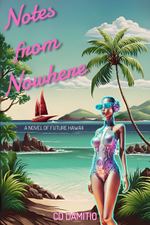
Readers and fans of Ursula K. Le Guin will really enjoy Notes from Nowhere — my post-pandemic utopian novel, a deliberate echo of William Morris’s News from Nowhere and a book that could not have existed without Le Guin’s example. A Honolulu socialist wakes from a COVID ward into the Pacific Mutuals — no money, no bosses, dishes with a two-year waiting list because people love to wash them. Have a look and let me know what you think.

CD Damitio writes at indignified.substack.com — essays on utopias, dystopias, and the spaces between. Free to read. No algorithm, no sponsored content. His books can be found on Amazon at https://www.amazon.com/stores/CD-Damitio/author/B001JP7NWA
CD Damitio writes INDIGNIFIED — utopias and dystopias explored. Free to read.