
I read this book twice. The first time was October 2020, sitting in a apartment in Honolulu with every window open and the trade winds coming through and an unemployment check stretched thin across the counter. The second time was a couple of weeks ago, in a rented room with the shutters closed against whatever was happening outside. Two readings, five years apart, two different men. Same book.
The first read, I thought this was a thriller. India gets hit with a wet-bulb heatwave in chapter one. Twenty million people die in a week. A lone survivor — Frank May, the American aid worker who should have died with them — walks out of the catastrophe with nothing left except the certainty that the people who did this have to be made to stop. The rest of the novel is a five-hundred-page argument about what “made to stop” actually means.
The second read, I realized it isn’t a thriller. It’s a procedural. Robinson is writing the administrative paperwork of saving the world, and the thrill comes from recognizing that paperwork is, in fact, what saves worlds. A UN subsidiary body in Zurich. Carbon coins. A central bank policy change. A targeted assassination campaign that nobody quite admits to. Refugee camps in Switzerland that become small towns. A sailboat voyage from Mumbai to Alaska that reads like a pilgrimage. And every few chapters, a six-page interlude where a proton or a photon or the blockchain itself speaks in the first person about what it has witnessed.
What changed between readings was me, not the text. In 2020, I was watching a slow-motion institutional collapse and reaching for a book that would let me feel a way out. I read it as hope. In 2026, I’ve lived five more years inside the collapse, and Robinson’s book doesn’t read as hope anymore. It reads as a manual. The wet-bulb event in chapter one is not a dramatic device. It is a dated entry in a ledger we are still keeping.
The thing that struck me on the second read — and that I missed the first time — is how unsentimental he is about the people. Frank May is not redeemed by his grief. He never quite recovers. Mary Murphy, who runs the Ministry, is not a hero. She is competent and tired and often wrong. The book does not reward its characters for their suffering. It reports on it and moves on, the way the survivors of a wet-bulb event would have to move on, the way all of us will.
Two moments I underlined.
One is late, when Mary is being interviewed and someone asks her whether she thinks they’ll make it. She says: I don’t know. But I know the alternative is not trying. That’s as close as Robinson gets to uplift. He won’t grant the reader more. He won’t grant himself more.
The other is a throwaway description of post-collapse Zurich, where the refugees have stayed and the city has absorbed them and the cost is paid in discomfort rather than death. Robinson writes that Switzerland “had learned the hard way that a rich country is just a poor country that hasn’t been tested yet.” I sat with that for an afternoon.
If you’ve been circling climate fiction and finding it either too doom-porn or too technocratic-boosterish, this is the book where the two settle an argument. Robinson’s gift — and it is a rare one — is taking institutional action seriously as a form of storytelling. Nothing explodes. Everything happens. Many people die. Many people also, stubbornly, don’t.
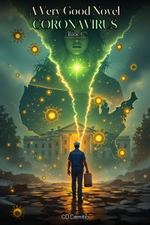
I wrote my own pandemic novel during the first lockdown in Honolulu — different register, same nerve. Where Robinson is institutional and patient, I was furious and fast. A Very Good Novel: Coronavirus has Gaia engineering the virus as a corrective, Trump profiting in real time, a Postmaster General chasing a sack-of-flour-shaped man named Bob, and California seceding. If you liked the fury underneath Robinson’s calm, or you wanted Ministry to be a little meaner, you’ll like mine.
Readers and fans of Kim Stanley Robinson will really enjoy A Very Good Novel: Coronavirus — my 2020 pandemic novel, written in lockdown while it was happening. Have a look and let me know what you think.

CD Damitio writes at indignified.substack.com — essays on utopias, dystopias, and the spaces between. Free to read. No algorithm, no sponsored content. His books can be found on Amazon at https://www.amazon.com/stores/CD-Damitio/author/B001JP7NWA
CD Damitio writes INDIGNIFIED — utopias and dystopias explored. Free to read.