
I bought my copy in 2002 at Powell’s in Portland, in the used travel section, on a table with other oddballs that didn’t fit anywhere else. It cost me seven dollars. It has since come with me to Alaska, Oregon, Hawaii, Morocco, Istanbul, Tokyo, and Otaru. It has been rained on twice. It has a grease stain on page 217 from a kebab in Fez. It has pages that fell out and got taped back in. It is, in every sense, the opposite of a coffee-table book. It is a field manual.
If you have never seen Zeek: The Art of Shen Ku, I will try to describe it. It is a 380-page hand-drawn encyclopedia of how to do things. How to build a shelter. How to tie a knot. How to identify a constellation. How to find water in a desert. How to throw a knife. How to read a handprint. How to meditate. How to fix a radio. How to catch a fish without a hook. How to disappear. How to pray to a tree. How to survive. Zeek — one name, no last name, a retired signal-painter who spent decades compiling this — drew every page himself in a kind of hybrid of Japanese calligraphy, Leonardo’s notebook, and a Whole Earth Catalog gone fully feral. The prose is aphoristic. The illustrations are better than they need to be.
This is not a book you read. It is a book you keep in the side pocket of a backpack that has done too many miles, and you open it when you are stuck — stuck on the side of a road, stuck in a bad mood, stuck waiting for a ferry, stuck in your own head. You open it at random. It never gives you what you came for. It gives you something better. A diagram of fourteen grips for a walking stick. Seven ways to sit on a rock. A two-page spread on what to do when a bear approaches. A rant, in tight handwriting, about why civilization has forgotten how to be bored.
I have read this book in the following places and each reading was a different book.
A VW bus I was living out of, 2002. First reading. I thought it was a gag. A novelty. A handbook for people who wanted to pretend to be frontiersmen. I was wrong but it took years.
A back porch in Honolulu, 2008. I was hiding out from a bad job. I opened it to a page about fire by friction and realized, watching a Hawaiian uncle light a bowl of poke with a battered Zippo thirty feet away, that Zeek wasn’t telling me to make fire without a lighter. He was telling me to notice that I could.
A rooftop in the Fez medina, 2011. I read the page on tea. Three pages, entirely about tea. He takes tea more seriously than most monks take scripture. I was drinking mint tea with my future in-laws, badly, and I realized I was drinking it wrong, and the book had told me, and I hadn’t listened.
What Zeek understood — and what almost no other self-reliance book has understood since — is that practical skills are a philosophy. You cannot tell someone how to survive without telling them why survival is worth the trouble. Zeek believes it is worth the trouble. He also believes that most of civilization’s noise is a distraction from the question. He draws a lot of pictures of small quiet things: a candle, a rope, a cup.
It is not a book for the person who wants to be off-grid. It is a book for the person who already suspects they are, and just needed confirmation.
This review continues a thread I’ve been pulling on for years — see William S. Burroughs, Junkie, Vagabond, a different kind of fellow-traveler to Zeek, though the two men would not have recognized each other in a bar.
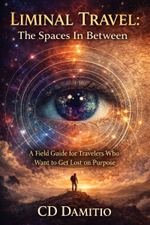
Readers and fans of The Art of Shen Ku will really enjoy Liminal Travel: The Spaces In Between — my own guide for the traveler who doesn’t fit the usual categories. Less illustrated, more argumentative. Includes chapters on suffering well, finding accommodation without booking ahead, and a portable framework for meaning I call Baoism. Have a look and let me know what you think.

CD Damitio writes at indignified.substack.com — essays on utopias, dystopias, and the spaces between. Free to read. No algorithm, no sponsored content. His books can be found on Amazon at https://www.amazon.com/stores/CD-Damitio/author/B001JP7NWA
CD Damitio writes INDIGNIFIED — utopias and dystopias explored. Free to read.