
I have read this book three times. Each time it has been a different novel.
The first time I was twenty-one, in a small rental in Bellingham, working a shift job, reading the Mirra Ginsburg translation because that was the edition at the used bookstore. I read it as a wild comedy. A devil named Woland arrives in 1930s Moscow accompanied by a giant black cat named Behemoth, a knife-throwing demon named Azazello, and a gangly assistant named Koroviev. They wreak havoc at a writers’ union, make a Variety Theater audience catch counterfeit bills that turn to paper at midnight, and hold a midnight ball attended by the great dead of history. I laughed through the book. I did not notice what it was doing underneath.
The second time I was thirty-three, in Manisa, reading the Pevear and Volokhonsky translation which had come out more recently and which rendered the Russian more literally at the cost of some of the English ease. By then I knew what the book was doing underneath. I understood that Woland and his retinue are not villains. They are the only honest characters in a Moscow that has been evacuated of honesty by a Stalinist literary bureaucracy that rewards lying and punishes truth. The devil, in Bulgakov, is not evil. The devil is the moral instrument that arrives in a society that has tried to abolish moral instruments, and that exposes, by his presence, every compromise the society has made with itself. The book is a satire of the Soviet literary establishment, but it is also a theology — Bulgakov is arguing, on the far side of the Russian revolution that had promised to abolish God, that the abolition had not worked, and that what had been abolished had only changed its name. I read the book at thirty-three and did not laugh. I wrote in the margin of the first page: this is the saddest book ever written by a man who kept his sense of humor.
The third time was last year, at the kitchen table in Otaru, through the cold end of the winter, reading the same Pevear and Volokhonsky edition my wife had given me years earlier. By then I had learned about Bulgakov’s life — that he wrote this novel in secret, over twelve years, while working as a literary factotum for the Stalinist regime that had forbidden him from publishing his real work. That he burned the first draft in 1930 in a fit of despair. That he began it again. That he dictated the final corrections to his wife Yelena in 1940, on his deathbed, while blind from nephrosclerosis. That the novel was not published in any form until 1966, twenty-six years after his death, and then only in a censored serialization. That the full, uncensored text did not appear in Russian until 1973, and that Bulgakov’s widow lived just long enough, just barely, to see the book she had preserved from the manuscript she had refused to burn finally reach its readers.
This is the book I read the third time. It is a different book. It is a document of a man who knew, while writing it, that he would not live to see it published — that he was writing into the drawer, for a readership that might or might not arrive after his death, and that the writing itself was an act of faith that the future would be different enough from the present to permit what the present had forbidden. This is the rarest thing a writer can do. Most writers write for the readers they already have. Bulgakov wrote for the readers he was not allowed to have. The novel is the argument that such readers would eventually exist. They did.
The Master and Margarita themselves — the title characters — are side characters in the first half of the book. They do not appear fully until the novel is already two hundred pages in. The Master is a novelist who has written a book about Pontius Pilate that the Moscow literary establishment has destroyed him for, and he is now in a psychiatric hospital. Margarita is the woman who loves him. The book’s climax is her bargain with Woland — to be queen of his midnight ball in exchange for the restoration of the Master and the manuscript of his novel. She accepts. She flies naked over Moscow on a broom. She presides over the ball. She gets what she asked for. This is, in the middle of a satirical anti-Soviet novel, one of the great love stories of twentieth-century literature, and the reader comes out of the midnight ball chapter changed.
The Pilate sections. Throughout the book, Bulgakov interleaves chapters from the Master’s novel — a reimagining of the trial and death of Yeshua Ha-Notsri, told from the perspective of Pontius Pilate. These chapters are written in a different register — somber, ancient, classical — and they are doing the theological work the satirical chapters cannot do. Pilate, in Bulgakov, is the paradigm case of the bureaucratic functionary who knows he is condemning an innocent man and does so anyway because the institutional incentive structure requires it. He is every Stalinist administrator. He is, possibly, every administrator of every system in every century. Bulgakov places him at the center of the novel because Pilate is the shape of the moral problem the whole book is trying to name.
The third reading was the one that undid me. The second had shown me the satire. The third showed me the grief. Bulgakov knew he was dying. He knew the book would not be published in his lifetime. He knew that the cowardice he had diagnosed in every major character — the Master’s cowardice in burning his own manuscript, Pilate’s cowardice in signing the death warrant, the Moscow writers’ cowardice in signing the denunciations — was a cowardice he himself could not fully escape, because he had spent his last decade writing flattering stage adaptations for Stalin in order to be permitted to live. He is the most honest writer of his generation because he knew, and wrote, his own compromises.
The book will be there on the fourth reading. I know what I will find. I will find another Bulgakov, another Moscow, another level of the joke beneath the last one. That is what great novels do. They are not objects to be finished. They are companions to be visited.
A related vagobond.com piece: On Translation and Survival.
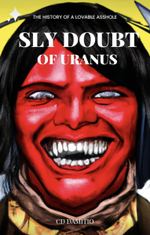
Readers and fans of The Master and Margarita will really enjoy The Sly Doubt of Uranus — my own novel in which the unexpected arrives in a city that has forbidden the unexpected, and in which the forbidden thing turns out to be the only honest inhabitant. Different decade, different devil. Same problem. Have a look and let me know what you think.

CD Damitio writes at indignified.substack.com — essays on utopias, dystopias, and the spaces between. Free to read. No algorithm, no sponsored content. His books can be found on Amazon at https://www.amazon.com/stores/CD-Damitio/author/B001JP7NWA
CD Damitio writes INDIGNIFIED — utopias and dystopias explored. Free to read.