
Before I read Midnight’s Children, I knew Salman Rushdie as the man the ayatollah wanted dead. That was almost everything. The fatwa had been issued in 1989 for The Satanic Verses, a book I had not yet read, and Rushdie had been in hiding for most of my teenage years, and he had emerged in the late 1990s blinking and cautious and somehow more famous than any novelist of his generation, because infamy had done for him what talent alone could not have.
Midnight’s Children came out ten years before the fatwa. It was his second novel. It won the Booker Prize in 1981, and won the Booker of Bookers in 1993, and won the Best of the Booker in 2008, which is to say — the Booker establishment has awarded this book its highest honor three separate times, because the book keeps outlasting the novels submitted against it. This is not an accident. It is the book of its generation. It is the book that broke English-language fiction out of the last of its post-colonial politeness and made it finally possible for a South Asian novelist to write in English without apologizing for the language.
Here is the context the book was written into. In 1981, the dominant tradition of post-independence Indian writing in English was what critics called the Indo-Anglian novel — modest, realist, often autobiographical, deeply embarrassed about the imperial provenance of the English language it was being written in. R. K. Narayan. Kamala Markandaya. The careful ones. Rushdie, born in Bombay in 1947 — on the fifteenth of August, midnight, the exact hour India became independent of Britain — had no patience for the apology. He decided the English language, having been dropped on the subcontinent by the empire, now belonged to the subcontinent, and that a novelist writing in English owed no deference to the tradition that had delivered the tongue. He wrote Midnight’s Children in what he called chutnified English — a prose saturated with Hindi and Urdu and Bombay street slang and the rhythm of the Indian oral storytelling traditions he had grown up listening to. The prose was the argument.
What the book is about: Saleem Sinai, born at the exact moment of Indian independence, is one of a thousand and one children born in the first hour of the new nation, each of whom possesses a different magical power. Saleem’s power is telepathy. He can gather the thousand and one children in a conference of the mind. His life, and the lives of the other midnight’s children, become the secret magical counterpart to the official political history of India from 1947 to 1977. Every major historical event — Partition, the Indo-Pakistani wars, the Emergency under Indira Gandhi — registers in Saleem’s body. He is, literally, the nation. The nation, figuratively, is him. The question the novel asks is whether the nation, and the novelist who has taken the nation’s body for his own, can survive what the nation does to itself.
This was a new kind of novel in English. It was not a new kind of novel in Latin American Spanish — Márquez had done something structurally similar in One Hundred Years of Solitude fourteen years earlier — but Rushdie was the first to import the magical realism of the Latin American boom into a post-colonial English-language context, and the first to make the import feel like a homecoming rather than a transplant. The magical realism Rushdie uses in Midnight’s Children is not Márquez’s. It is derived from the Indian oral traditions — the Ramayana, the Mahabharata, the kathak storyteller, the Bollywood melodrama. The novel is simultaneously a Booker-winning British literary event and a translation into English of a thousand-year-old Indian narrative tradition that had always worked this way.
Every Indian and subcontinental novelist who came after Rushdie worked in the space he opened. Arundhati Roy’s The God of Small Things. Vikram Seth’s A Suitable Boy. Jhumpa Lahiri’s work in its entirety. Amitav Ghosh. Kiran Desai. Mohsin Hamid. The whole second generation of South Asian writing in English operates inside the linguistic permission Midnight’s Children established. They argue with Rushdie. They depart from him. They cannot write as if he had not written.
The book is long. It is dense. The first hundred pages are the hardest — Rushdie spends them establishing Saleem’s grandfather and his Kashmiri childhood and the pre-history of the family, and many first-time readers put the book down here, and this is a mistake, because the payoff of the first hundred pages happens six hundred pages later and redeems the length entirely. If you are going to read it, give it the first two hundred pages before judging. If you are going to read only one Rushdie in your life, this is the one, not Satanic Verses, and not the later books, which are uneven — brilliant in patches, exhausted in others, the work of a man writing from inside a cage of security measures he was not designed to write inside.
Read Midnight’s Children as the book it was before it became the second-most-famous work by a writer made famous by an assassination threat. It is, in itself, one of the great novels of the twentieth century. The fatwa is not the frame. The fatwa is something that happened to the man who wrote the frame.
A related vagobond.com piece: On Translation and Survival.
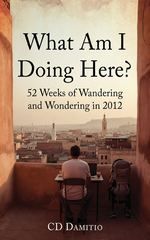
Readers and fans of Midnight’s Children will really enjoy What Am I Doing Here? — my own sprawling book about a life born into one century and lived out into another, with the sideways magic and the fractured family and the strange accidental intersections with history that a novelist in my position inherits. Different subcontinent. Same shape. Have a look and let me know what you think.

CD Damitio writes at indignified.substack.com — essays on utopias, dystopias, and the spaces between. Free to read. No algorithm, no sponsored content. His books can be found on Amazon at https://www.amazon.com/stores/CD-Damitio/author/B001JP7NWA
CD Damitio writes INDIGNIFIED — utopias and dystopias explored. Free to read.