
From the margins of my copy of Life Ahead, a Krishnamurti book that was given to me by someone who, in retrospect, was trying to tell me something.
Page 4, margin: Is he talking to children here or to us. — written in pencil, underlined twice. The book is addressed to students at a school in India in 1953. He speaks to them as if they were adults. He speaks to the adult reader as if we were students. The distinction collapses within about ten pages.
Page 19, margin: “Most of us are educated to fit into society.” Yes. And most of the people who notice this become teachers of fitting-in-less, which is still a way of fitting in, only in a different room. K. is aware of this. He keeps warning against his own warnings. Hard to do.
Page 33, bottom, heavily underlined: “Truth is a pathless land.” This is the famous sentence. The one from the 1929 dissolution speech. The one that got him excommunicated from the Theosophical Society that had been grooming him for decades to be their World Teacher. He repeats it in various forms throughout Life Ahead, and reading it again I realize how much of the twentieth-century spiritual marketplace exists as a rebuttal to this one sentence. Paths sell. Pathless lands do not.
Page 47, margin: He is saying you cannot learn freedom from an authority on freedom. Circled. With an arrow pointing to the word AUTHORITY.
Page 58, margin: If this is right — and it might be — then reading this book is a problem. And again, in different ink: he knows this. Keep reading.
Page 71: “The right kind of education is concerned with individual freedom, which alone can bring true cooperation with the whole.” Margin: he is not a libertarian. He is not a collectivist. He does not care about your categories. He wants the individual awake enough that the category stops being useful.
Page 89, heavy marking: a whole paragraph underlined, about fear. K. says fear is not something you have. Fear is something you do — a continuous action, like breathing, that happens below the level of noticing, and that shapes every thought and act that occurs on top of it. Margin: This was the thing. — written in a different pen, later. This was the thing I needed to hear at twenty-four and did not hear. Cost me a decade.
Page 104: “You cannot depend on anyone. There is no guide, no teacher, no authority. There is only you.” Margin: and yet here I am, reading it from a teacher. Smaller, beneath: he is trying to hand the book back to me. Take the book.
Page 118, on loneliness vs aloneness: Loneliness is the condition of being cut off from the thing you wanted. Aloneness is the condition of being complete without the thing you wanted. Margin: The difference is thirty years of practice.
Page 132, underlined: “The mind that has accumulated cannot discover.” Margin: This is the argument against the life I am currently living. Noted. Declined. And later, in different ink: Revisit.
Page 148, a whole section on competition: K. says the school system of every industrialized country is built on competition, and that competition produces not excellence but anxiety, and that anxiety produces not achievement but obedience, and that obedience is what the system actually wanted all along. Margin: He published this in 1963. It has gotten worse. Beneath: much worse.
Page 163: “Do not follow me. Do not follow anyone.” Margin: I like him more because he keeps saying this and meaning it. Most people who say this are being coy. K. is not being coy.
Page 177, back cover inside: a long note in pencil. Finished this in the kitchen. Honolulu. The person who gave me this book said I would either throw it across the room or underline the whole thing. I did both. The book is right. I am not yet right. That is what the book is about.
Krishnamurti talked for sixty years and wrote nothing himself — every book is a transcription of his spoken dialogues. Life Ahead is a small one, a student-facing one, a good one to give to someone in their twenties who is already suspicious of authority but has not yet noticed that suspicion is also an authority. It does not change your life on one reading. It changes your life by being there on the shelf for decades, and being picked up in bad seasons, and being put down when you are not ready, and being picked up again when you are. It is a patient book. I have been patient back.
A related thread on vagobond.com: Travel Writing — Dangerous Business.
The philosophy that grew out of this kind of reading I call Baoism. Bao Ji — Bring Your Own. K. would have approved of the refusal to sell it.
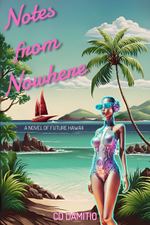
Readers and fans of Life Ahead will really enjoy Liminal Travel: The Spaces In Between — my travel book for readers who suspect that the way we travel is a way of not arriving, and who are looking for the pathless version. Includes a chapter on Baoism. Have a look and let me know what you think.

CD Damitio writes at indignified.substack.com — essays on utopias, dystopias, and the spaces between. Free to read. No algorithm, no sponsored content. His books can be found on Amazon at https://www.amazon.com/stores/CD-Damitio/author/B001JP7NWA
CD Damitio writes INDIGNIFIED — utopias and dystopias explored. Free to read.