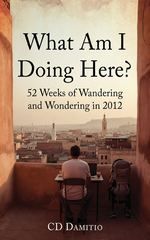

I first saw this book at a swap meet in Reedsport, on a card table under a tarp, in a box marked TWO DOLLAR EACH. The seller was an old man smoking a pipe who did not seem interested in selling anything. I picked up the Buryn — a 1971 edition, spine broken, the cover photograph bleached by whatever window the book had sat in for fifty years — and he looked at me and said, one dollar. I did not argue. I carried it home in a paper bag.
I mention the provenance because the book is the kind of book that has provenances. Copies of Vagabonding in Europe and North Africa almost never arrive at a person through a normal channel. They are given. They are found. They are slid across the table at 3 a.m. by someone in a hostel common room who says this will explain what we have been trying to explain. Ed Buryn wrote the original guide to leaving, and the book itself left, in the sense that it went out into the culture and never came back to the publisher’s warehouse. The 1971 edition is still the edition I recommend. The later ones were updated and the updates hurt.
What is the book? On its surface, it is a practical handbook for traveling Europe and North Africa on almost no money in the early 1970s. How to hitch. How to sleep in train stations without being robbed. How to negotiate with a Moroccan customs agent. How much a loaf of bread cost in Portugal in 1970. The practical information is of course obsolete. The bread costs more. The customs agents have different uniforms. The hitchhiking economy that made the whole scheme possible has been dismantled and will not come back.
Under the surface — which is where you have to read it, because the surface is dated — the book is a metaphysics. Buryn is not writing about how to travel cheaply. He is writing about what travel is, and he argues, gently, that most of what his fellow Americans called travel in 1971 was a form of staying home while moving. The hotel. The bus tour. The checklist. The photograph. All of it, he says, designed to protect you from the country you paid to enter.
The vagabond, in his definition, is the one who lets the country enter him. Who has no itinerary. Who carries too little. Who arrives with empty time and permits the place to fill it. Who does not know, in the morning, where he will sleep at night, and who treats this not as a problem but as the primary condition of being awake in a foreign place.
I read this book first in Reedsport and then, over and over, in the places it turned out to be about. I carried my copy — the one-dollar copy — to Portugal, Morocco, Turkey, Greece. It got water-damaged on a ferry between Patmos and Kos. It got a coffee ring in Sefrou. It developed a smell. When I moved to Manisa I left it on the shelf in the guest room for any traveler who stayed with us, because it seemed to me the book was trying to get back into circulation, and I was only a way-station.
Buryn died in 2015. He lived long enough to see his book become a cult object, long enough to see the word vagabonding become a travel-blog cliché, long enough to see his basic proposition — that you could leave your life and be improved by the leaving — be first romanticized, then commodified, then sold back to the children of the people who had read him sincerely. He did not write a bitter epilogue. He should have. Someone should.
If you read it today, read the 1971 edition if you can find one. Skip the practical chapters. Read the opening essay on vagabonding as a state of mind. Read the closing notes on coming home. Everything in between is the infrastructure of a world that no longer exists. The opening and closing are the argument, and the argument is still alive, because the thing it was arguing against — the package tour, the sanitized arrival, the photographed absence — has only gotten stronger.
A related vagobond.com piece: Around the World Through a Photographer’s Lens — China.
The philosophy I’ve been working out from this kind of reading I call Baoism. Bao Ji — Bring Your Own. Your teachers, your practices, your road.
Readers and fans of Vagabonding in Europe and North Africa will really enjoy Liminal Travel: The Spaces In Between — my travel book written for the people Buryn was writing for, two generations later, in a world where the cheap ways of being gone have been mostly legislated away and a new set has to be found. Includes the chapter on coming home that Buryn never wrote. Have a look and let me know what you think.

CD Damitio writes at indignified.substack.com — essays on utopias, dystopias, and the spaces between. Free to read. No algorithm, no sponsored content. His books can be found on Amazon at https://www.amazon.com/stores/CD-Damitio/author/B001JP7NWA
CD Damitio writes INDIGNIFIED — utopias and dystopias explored. Free to read.