
Here is the contrarian take, and I am aware it is unfashionable in literary company: The Pillars of the Earth is a better novel than most of the literary fiction published in the same year, and has been underrated for the past forty years because its author was a thriller writer who violated an unspoken genre contract by writing an honest, deeply-researched, structurally ambitious historical novel that does not have the prose pyrotechnics the literary establishment requires before it will grant seriousness. Follett’s crime was to be too readable. The establishment held it against him.
The book was published in 1989. Follett had, by that point, published eleven thrillers — Eye of the Needle, Triple, The Key to Rebecca — and was making a comfortable living on them. Pillars was the book he had been wanting to write for a decade. He researched it for three years. It runs to a thousand pages. It is set in twelfth-century England during the period known as the Anarchy — the civil war between Empress Matilda and King Stephen, 1138 to 1153, during which the central authority of the English crown effectively collapsed and the country was ruled by regional strongmen who did what they wanted. Follett places a fictional town called Kingsbridge at the center of the story. The plot tracks four decades of an attempt to build a Gothic cathedral there, across the lives of four generations of builders, priests, peasants, and nobles, and it tracks the unbuilding at the same pace — the burning villages, the starvation, the raids, the gradual destruction of whatever the builders built.
The critical reception in 1989 was mixed-to-negative. Literary reviewers found the prose workmanlike — which it is — and the sex scenes pedestrian — which they are — and the villainy cartoonish — which it sometimes is, particularly in the character of the sadistic knight William Hamleigh. They concluded, on these grounds, that the book was a well-made popular entertainment and not serious literary fiction, and they moved on. The reading public did not. Pillars has sold more than twenty-seven million copies, has spawned three sequels, a TV miniseries, a board game, a musical, and a dedicated online fan community that rereads it on a multi-year rotation. Oprah selected it for her book club in 2007, which doubled the sales again. It is, by most measures, the most successful piece of historical fiction published in the second half of the twentieth century.
The reason the book is better than its reviews is that Follett got the cathedral right. This is the hidden structural feat nobody talks about. Follett is not writing a novel about medieval people. He is writing a novel about the building of a Gothic cathedral, and the novel’s architecture mirrors the cathedral’s architecture — the long arcs, the weight-bearing characters, the repeated motifs across generations, the way the whole enormous structure is held up by tension against tension across a very long span. A reader who has actually stood inside Wells or Durham or Lincoln Cathedral and then reads Pillars will notice that Follett has produced, in prose, the experience of being inside a Gothic space — the slow unfolding, the cumulative awe, the sense of being inside something that took hundreds of people more than their own lifetimes to make. Most historical novelists write about their period. Follett, in this one book, made the novel itself structurally of its period.
The other thing he got right is the labor. Pillars is the best novel I have read about how pre-industrial skilled labor actually worked. The master builder Tom Builder, the apprentice Jack Jackson, the stone quarries, the scaffolding collapses, the winter freeze-offs, the strikes by craftsmen against underpayment, the slow transmission of technique from master to apprentice over decades — all of this is rendered with the granular accuracy of a writer who had interviewed working masons and studied the medieval fabric rolls of the actual cathedrals that survive. This is not the medieval world of Ellis Peters or Rosemary Sutcliff. It is the medieval world of men lifting heavy stones for thirty years while the politics above them shifts regularly. Follett makes you feel the weight.
What he got wrong: the ideology. Pillars is, politically, a nineteenth-century liberal novel in medieval costume — it believes in individual merit triumphing over corrupt institutions, it believes in love conquering arranged marriage, it believes in rational progress defeating superstition, and all three beliefs are imposed on a twelfth century that would not have recognized them. Follett knows the cathedral. Follett knows the labor. Follett does not know the medieval mind. His medieval characters think like 1980s British progressives in tunics. This is the standard failure of historical fiction and Follett is not exempt from it.
What doesn’t matter: this failure. It doesn’t matter because the novel is not, finally, about the twelfth century. It is about what it takes to build something large and good in the middle of a collapsing political order, and about the long cost of building it, and about the generations of unnoticed labor that the finished thing will be credited for. Read in 2026, in a collapsing political order, the book is startlingly contemporary. Kingsbridge is not medieval England. Kingsbridge is any community trying to build something in a period when the central authority has stopped functioning and the regional strongmen are doing what they want. The twelfth century is the costume. The subject is the present.
A reader who has been told that Pillars is a popular thriller should correct the description. It is not a thriller. It is a long, patient, structurally sophisticated novel about collective labor across generations. Read it in winter. Read it slowly. Read it, if you can, alongside a book about an actual cathedral — Jean Gimpel’s The Cathedral Builders, or John James’s work on Chartres — so that the fiction and the fact can inform each other. The book earns its length. The length is the pacing the subject requires.
A related vagobond.com piece: On Translation and Survival.
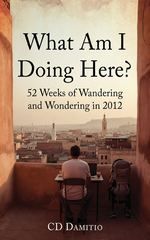
Readers and fans of The Pillars of the Earth will really enjoy What Am I Doing Here? — my own collected account of a life spent trying to build small good things inside a collapsing order. Different cathedral. Same question. Have a look and let me know what you think.

CD Damitio writes at indignified.substack.com — essays on utopias, dystopias, and the spaces between. Free to read. No algorithm, no sponsored content. His books can be found on Amazon at https://www.amazon.com/stores/CD-Damitio/author/B001JP7NWA
CD Damitio writes INDIGNIFIED — utopias and dystopias explored. Free to read.