
I first read this book at nineteen, in a library in Bellingham, from a copy I did not own and could not afford to own. I remember thinking Hubbard was the smartest man I had ever read. Every page a small detonation. Every epigram ready to be stolen and presented at a party as my own. I copied pages of it into a spiral notebook and for about six months I quoted him so often that a girl I was trying to impress told me, kindly, to shut up.
I read him again in my thirties, in Honolulu, from a Roycroft edition I bought at an estate sale for two dollars, and I thought Hubbard was a pompous ass. Every page a small vanity. Every epigram the sound of a man who had figured out that if you said things with enough confidence, nineteen-year-olds in Bellingham would copy them into spiral notebooks.
I read him again last year in Otaru, through a winter, slowly, at the kitchen table, and I saw a third man. Not the genius. Not the pompous ass. Something in between that I can only describe as a working American who had built his own printing press and his own community and his own furniture shop, who had opinions about everything because his life had opinions about everything, and who wrote the way a man writes when he has no editor and no shame.
Elbert Hubbard was a soap salesman before he was a writer. He went to visit William Morris at Kelmscott in 1894 and came home to East Aurora, New York, with the idea that America needed its own Arts and Crafts movement, and he built one. The Roycroft community at its peak had five hundred people in it making books and furniture and hammered copper lamps. He wrote a tract called A Message to Garcia in 1899 that sold forty million copies and was distributed by the Russian government and the Japanese government and the United States Navy. He died in 1915 when a German submarine sank the Lusitania, and the last eyewitness said he and his wife went back to their cabin hand in hand and closed the door.
The Notebook is the book his son Elbert II assembled after the drowning, from a decade of his father’s journals and marginalia. It is not organized. It does not have a thesis. It is a man’s thinking in the order his thinking arrived. On one page he is tender about a woodworker. On the next he is appalling about women. On the page after that he has noticed something about Thoreau that nobody had noticed before him and nobody has noticed as well since.
What I missed at nineteen: the contradictions. I read him as a prophet, so I flattened him. What I missed at thirty-five: the workshop. I read him as a fraud, so I dismissed the hammered copper. What I got, this last time, was the whole thing at once. A man with a hundred opinions, some wrong, some ahead of their time, some behind even his own time, all arranged in the exact order of a life lived in one place with one set of hands.
The book is not great. I want to say that plainly. There are better aphorists — Bierce, Twain, La Rochefoucauld. There are better memoirists of the American self-made. There are better anarchists, better craftsmen, better essayists on art. What Hubbard has that the better ones do not is volume. He wrote so much, about so much, that reading him is less like reading an author and more like opening the hood of a twentieth-century American mind and seeing every part of it still running, some of it well, some of it badly, all of it yours whether you want it or not.
That is why the book is worth three readings. The first reading is for the epigrams. The second reading is for the disenchantment. The third reading is for the engine itself.
I am not twenty anymore. I will not be copying anything into a spiral notebook. But I have the book on the shelf now, and I expect I will read it a fourth time before I am done, and I suspect I will find a fourth Hubbard waiting. The book keeps producing him. That is what old books do when you keep coming back.
A related piece on vagobond.com: Travel Writing — Dangerous Business.
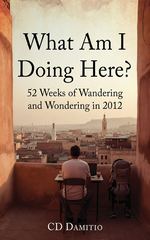
Readers and fans of The Notebook of Elbert Hubbard will really enjoy What Am I Doing Here? — my own collected notebook of a working writer’s mind: the opinions, the contradictions, the things I got wrong on first pass and had to come back to. Less finished than Hubbard. More honest for it. Have a look and let me know what you think.

CD Damitio writes at indignified.substack.com — essays on utopias, dystopias, and the spaces between. Free to read. No algorithm, no sponsored content. His books can be found on Amazon at https://www.amazon.com/stores/CD-Damitio/author/B001JP7NWA
CD Damitio writes INDIGNIFIED — utopias and dystopias explored. Free to read.