
You cannot read this book properly in a city. You need a desert. Not a metaphorical one. An actual desert — the kind with junipers stunted into witch-knots by the wind, the kind with slickrock that has been polished by ten thousand years of water that is no longer there, the kind where the horizon is not softened by haze and the distance between you and what you can see is the actual distance and not a photographic convention. Abbey wrote The Monkey Wrench Gang for that kind of place. Read in that kind of place, the book works. Read anywhere else, the book does not quite work, because the book is making an argument the reader cannot assess without the evidence the desert provides.
I read it first in the American southwest, in 1998, on a long road trip I took after I got out of the Marines, camping by myself in the Canyonlands country Abbey had written about in Desert Solitaire thirteen years before Monkey Wrench. I was twenty-six and angry and the book walked straight into the angriest room in my head and sat down and started talking. I read it by campfire. I read it in the back of a pickup truck. I read it with a thermos of coffee in the morning on a rim over a canyon the name of which I have lost. I finished it on a bench at a bus station in Moab, Utah, in the kind of summer heat that makes the asphalt give under your shoes.
Monkey Wrench is the 1975 novel about four people who begin sabotaging the industrial infrastructure of the American southwest — pulling up survey stakes, cutting up billboards, blowing up bulldozers, eventually planning an assault on the Glen Canyon Dam — because they have decided the industrial destruction of the desert has become intolerable and the civil process has proven unequal to stopping it. George Washington Hayduke, ex-Green Beret, ex-Vietnam, ex-POW. Seldom Seen Smith, Mormon river guide with three wives in three towns. Doc Sarvis, Albuquerque surgeon with a fortune and a liver. Bonnie Abbzug, the young woman who is sleeping with Doc and who turns out to be the operational mind of the group. They meet at a river trip. They decide to go to work. The book is about the work.
Abbey wrote the novel in the mid-1970s, at the height of the federal push to industrialize the Four Corners — the coal mines at Black Mesa, the Navajo Generating Station, the planned dams on the Colorado, the strip-mining of the Kaiparowits Plateau. He was a park ranger at Arches, and then at Organ Pipe, and he had spent twenty years watching the thing he loved be dismantled by machines that were owned by men in board rooms in Chicago and served by men in hard hats who had no particular feeling about the desert either way. He wrote the book in a state of honest fury. The fury shows. The book is funnier than it has any right to be, because fury, in Abbey, produces comedy — he cannot be serious for longer than a page without someone cracking a beer or an engine blowing up or Hayduke announcing something unprintable — and the comedy is the load-bearing structure of the argument. You cannot sustain an argument this furious for three hundred pages without humor. Abbey knew. He made it work.
Earth First! — the radical environmental group that engaged in actual monkeywrenching operations against logging and dam-building in the 1980s and 90s — was founded in 1980, five years after the novel came out, by people who had read the novel and taken it as a manual. Dave Foreman. Mike Roselle. Howie Wolke. They were not confused about where the operational template came from. Abbey, for his part, was publicly ambivalent about the movement he had inspired. He supported it. He also distanced himself from specific actions. He knew the book was doing in the world what he had written it to do, and he also knew, as novelists often do, that being the moral author of actions you did not personally carry out is a complicated position.
What the book gets right, forever: the landscape. The long desert passages, the canyon-country geography, the specific topology of the four rivers — Colorado, San Juan, Green, Escalante — are rendered with a fidelity no post-war American novelist has matched. Abbey had walked the ground. He had floated the rivers. When the gang is on the slickrock at night, Abbey knows what the slickrock feels like under a boot at three in the morning. When they are ferrying dynamite across a creek at dawn, Abbey knows what dawn in that particular canyon looks like in July. The place is the point. The sabotage plot is the vehicle for the place.
What the book does not get right: the women. Bonnie Abbzug is a better character than most of Abbey’s critics give her credit for — she is the smartest of the four, she runs the operation more than Hayduke does, and the book’s Bonnie chapters are its most tender — but she is also written with a male gaze that was already dated in 1975 and is dated now, and a fair reader has to let that sit uncomfortably with the affection the book otherwise earns. Abbey was a man of his generation and his landscape, and both were male in specific ways, and the novel carries both.
What has not dated at all: the core anger. The feeling that the thing being destroyed is being destroyed on purpose, by people who know they are destroying it, for reasons that do not survive examination, and that the civil process is not going to save the thing. This feeling is more available to American readers now than it was in 1975. The Colorado River is thirty percent of the flow it was when Abbey wrote. The Glen Canyon Dam — the primary target of the book’s climax — is now under serious technical discussion for decommissioning because the reservoir is below minimum power pool. The book’s central proposition, that the industrial destruction of the American west was contingent rather than permanent, has aged into a kind of dark vindication. Abbey would not have been happy to be right. He would have been furious. Furious was his register.
Read this book in a desert. If you do not have a desert, save the book for the next time you are near one. Do not read it in a city. The city will not permit the book’s argument. The book needs the evidence.
A related vagobond.com piece: A Question of Authority: Can There Be Authority in an Anarchist Society.
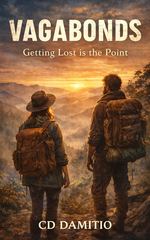
Readers and fans of The Monkey Wrench Gang will really enjoy Vagabonds — my road novel about American men who have stopped trusting the civil process and have started trusting each other instead. Different landscape, different decade, same anger. Have a look and let me know what you think.

CD Damitio writes at indignified.substack.com — essays on utopias, dystopias, and the spaces between. Free to read. No algorithm, no sponsored content. His books can be found on Amazon at https://www.amazon.com/stores/CD-Damitio/author/B001JP7NWA
CD Damitio writes INDIGNIFIED — utopias and dystopias explored. Free to read.