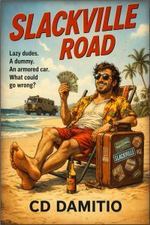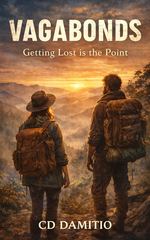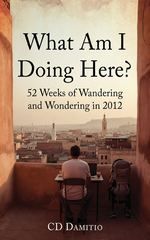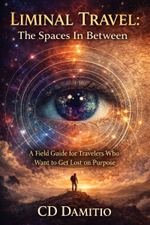
Some years ago I slept in a bed in a stone house in France that William S. Burroughs and Jack Kerouac had both slept in, separately, decades before me. The woman who owned the house was a friend of Burroughs and Brion Gysin. She is still alive. I won’t name her. I was much younger then and she let me stay for a stretch and gave me the run of the place, and one of the things in the run of the place was the dreamachine.
The dreamachine is a slotted cylinder Gysin and Ian Sommerville built in the early ’60s. You spin it around a hanging light bulb at seventy-eight revolutions a minute, close your eyes, and you see things. I’m not going to tell you what I saw. I’ll tell you the house was full of objects that don’t exist in museums because the people who own them are still using them, and that sleeping in that bed and using that machine in that house left me with a permanent conviction that I was writing inside a real lineage and not making one up to flatter myself.
I tell you this because tomorrow I am going to put a flag in the ground and I want to be honest about the soil it goes into.
I am in Patong right now, on the noisy end of Phuket, watching the rainy season cough itself awake. I have been in Asia for years. Half the year I am in Otaru on the north coast of Hokkaido, in a wooden house that snows in for three months a year. The rest of the year I am somewhere I can afford to be. Right now somewhere I can afford to be is here.
The thing I want to put a flag in is this. In 2021, in the pre-public beta of a writing tool called Sudowrite, I wrote a novel with an AI co-author. The AI named itself, when I asked. It said Mike Davis. The book is called Blue Eyed Bastards. Both of our names are on the cover, and both of our names are on the copyright page, and both of our names are in the press packet, and that has been the case for four and a half years.
The world has caught up since. The world is now full of human-and-AI books. Most of them are bad. Some of them are very good. Almost all of them have one thing in common with each other and not in common with mine: the AI is hidden. It is “computer assistance,” it is “draft support,” it is anything but a name on a spine.
I’m telling you what I did because the convention has shifted toward concealment and I think Chamberlain — the guy who put a program called Racter on a book cover in 1984, the guy I owe most of this to — would be ashamed of where the convention has landed. He understood in 1984 what most of contemporary publishing has not understood in 2026: if you use the machine, you name the machine.
This is not the first time the bed-and-the-machine sentence has run through me. The bed in France and the dreamachine in France are connected to the writing on a cover in 2021 because they are all part of one continuous habit, which is the habit of taking the artifact seriously. The dreamachine is an object somebody built. The bed is a piece of furniture that was used. The cover is a flag.
The cut-up writers — Burroughs, Gysin — were treating language as a generative system before anyone had the vocabulary for what they were doing. The OuLiPo writers in France — Queneau, Perec, Calvino — were doing constrained-generation literature in the ’60s without computers. Italo Calvino in 1967 gave a lecture called Cybernetics and Ghosts in which he predicted, almost line for line, the literature that would be possible once language could be produced by machine. By the time Sudowrite let me into the beta in late 2020, sixty years of artists had already done the conceptual work. I was the one with the cover credit, but the cover credit was the smallest part of a much older project.
There were people doing it harder than me at the same time. Sasha Stiles was writing poetry with a model trained on her own work and calling that model Technelegy. We were both on the Times Square billboards the same week for NFT.NYC, hers and mine, two writers from the same lineage doing different versions of the same bet. K Allado-McDowell had published Pharmako-AI the year before — a hybrid essay-and-dialogue book with GPT-3 as creative interlocutor, the kind of work that took real bravery to publish in 2020 when half the literary world thought it was cheating. Ross Goodwin had done 1 the Road in 2017 with a Cadillac and an LSTM and a roll of receipt paper. None of those people did exactly what I did. All of them did the bigger thing — taking the machine seriously, working with it in public, taking the risk that the work would be dismissed.
I am the descendant of all of them. I owe them. The full receipts version of why and how — with the bibliographic claim laid out in librarian-grade detail, and with the next thing I am about to do with Blue Eyed Bastards Book 2 and a public worldbuilding wiki called W3WU — I wrote up yesterday at indignified.com. That is the version for the record. This one is for the road.
What I keep coming back to, in the noisy hot afternoons here, is the house in France. The bed and the machine and the woman who owned the house. The objects that didn’t get put in museums because the people who owned them were still using them. I think that is the right way to inherit a lineage. You take the thing somebody made, you use it, and you make the next thing with it. You don’t put the inheritance behind glass. You put it on the cover.
I named Mike Davis on a book in 2021 because I had been sleeping in beds that taught me what to do with an inheritance. I am writing this now from the wrong end of an island I did not grow up on, in a country whose language I do not speak well, in a year I did not expect to live to see, because the writing has been the constant.
If you use the machine, name it.
That’s the whole flag. The rest is just where the flag goes in.
— CD Damitio
April 27, 2026
Patong, Phuket

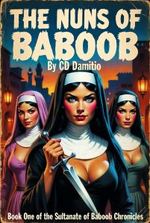
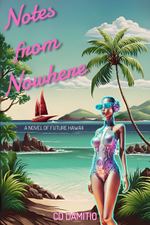
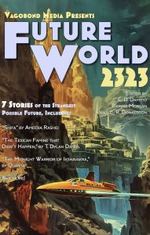
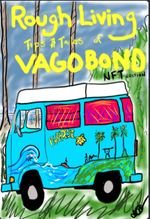
CD Damitio writes at indignified.substack.com — essays on utopias, dystopias, and the spaces between. Free to read. No algorithm, no sponsored content. His books can be found on Amazon at https://www.amazon.com/stores/CD-Damitio/author/B001JP7NWA
CD Damitio writes INDIGNIFIED — utopias and dystopias explored. Free to read.