
An imagined conversation with Abbie Hoffman, who killed himself in 1989 in a converted turkey coop in rural Pennsylvania, with the Chicago Seven trial thirty years behind him and the FBI file he had been fighting for twenty years still unfinished. I get to ask the questions. He can answer however he wants.
Me: Abbie.
Hoffman: Don’t Mr. Hoffman me. Mr. Hoffman was my father. He sold Texaco gasoline in Worcester. He was a good man. He would not have approved of me.
Me: Steal This Book. 1971. A handbook on free medicine, free food, free crash pads, free legal aid, shoplifting technique, bomb-making — a best-selling how-to guide for the American underground economy, written at the height of the Movement and aimed at kids who had run away to New York or San Francisco or Chicago and needed the operational intelligence.
Hoffman: That is what it was. Also a joke. Also a dare. Also a trap for the publishing industry that had refused to touch it — thirty rejections before Pirate Editions, my own imprint, finally put it out. The title is the instruction. If you steal the book, the publisher cannot count you as a sale, but you still have the book. Capitalism has no move against this. I was very proud of it.
Me: Fifty-five years later, we have the same question — what do you do when the distribution system and the surveillance system are the same system — but the tools are different. How would you write Steal This Book now.
Hoffman: Shorter. The whole section on how to make a payphone work for free would be gone, because payphones are gone. Most of the survival tactics would be gone, because the city they worked in is gone. Rent is not the same category it was in 1971. You could not squat an abandoned building in New York now the way we did in 1970, because there are no abandoned buildings in New York. The real estate class has fully inventoried everything. What I would add is how to survive in the surveillance economy — how to have an off-grid identity, how to move money without being traced, how to organize without your phone becoming evidence. I am not the right person to write this book. The person who writes it now will be someone who grew up inside the surveillance and knows it from the inside. I was a guest in it.
Me: The Yippies. The Festival of Life at the 1968 Democratic Convention. Levitating the Pentagon. The pig for president. The theatrical politics that put you on the Chicago Seven trial. You were indicted under the Anti-Riot Act that had been passed specifically to prosecute people like you. You spent five months on trial with Jerry Rubin and Tom Hayden and Bobby Seale. The trial was, depending on how you count it, either the single most effective piece of anti-war theater of the sixties or a humiliation dressed up as a comedy. How did you see it while it was happening.
Hoffman: Both. You do not get to choose. The trial was both things in the same room in the same minute, and anybody who tells you they separated the strands at the time is lying or was not paying attention. We made Judge Hoffman — no relation — look ridiculous because he was ridiculous. We also spent five months of our lives inside a federal courtroom while the war we were trying to end continued to kill thirty thousand people a month in Vietnam. A tactical victory that cost five months of strategic capacity is not an unambiguous win. I did not see this at thirty-two. I see it now.
Me: The FBI file. You were on the run from 1974 to 1980 under the name Barry Freed after a cocaine arrest you believed was a setup. You organized environmental campaigns up the St. Lawrence River while fugitive. You turned yourself in, served time, wrote two more books, toured colleges. In 1986 you were arrested at Amherst with Amy Carter for protesting CIA recruitment on campus. You were acquitted in a trial where the jury agreed the CIA’s covert operations were themselves illegal and your protest was therefore justified defense. That is the final victory of your public life. Are you content with it.
Hoffman: The Carter trial was a win. I was happy with it at the time. I was also already, by 1986, depressed in ways I could not reach. I had been depressive on and off for twenty years, and the lithium was not fully working, and the depression had begun to make the victories feel thin. A person who has been fighting for twenty-five years and has won some and lost more does not feel the wins the same way someone coming into a first win feels it. That is not a political observation. That is a psychiatric one. I should have said so more clearly when I was alive. The young organizers who looked up to me needed to hear that the long-term mental cost of the fight is as real as the physical cost, and I did not warn them, and some of them are now in their own rural Pennsylvanias, and I have not been able to reach them from here.
Me: Last question. The book is still in print. Young radicals still buy it. Its practical advice is useless. Its spirit is still useful. Is that the correct ratio.
Hoffman: That is always the ratio with a working book. Practical advice dates. Spirit does not. If you read Steal This Book to learn how to shoplift meat from a 1971 A&P, you will be disappointed and also you should probably not be shoplifting meat. If you read it to learn that the system can be refused, that the refusal can be funny, and that the funniness is tactical — then the book works, and will keep working until someone writes a better book in an idiom the new century will recognize. Write it. Don’t wait for my permission. I am not in a position to give it.
A related vagobond.com piece: A Question of Authority: Can There Be Authority in an Anarchist Society.
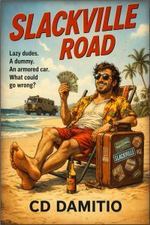
Readers and fans of Steal This Book will really enjoy Slackville Road — my comic novel about American refusers two generations after Hoffman, operating inside a surveillance economy he did not live to see but would have recognized. Less theatrical. Same spirit. Have a look and let me know what you think.

CD Damitio writes at indignified.substack.com — essays on utopias, dystopias, and the spaces between. Free to read. No algorithm, no sponsored content. His books can be found on Amazon at https://www.amazon.com/stores/CD-Damitio/author/B001JP7NWA
CD Damitio writes INDIGNIFIED — utopias and dystopias explored. Free to read.