The Beat Century — post 43 of 100. Robin Wall Kimmerer, Braiding Sweetgrass (2013).
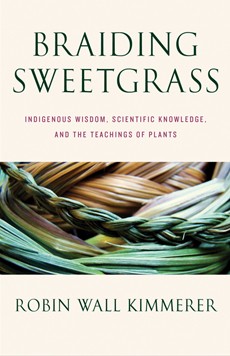
Robin Wall Kimmerer’s 2013 essay collection took seven years to reach the bestseller list and then would not leave it, arguing that scientific knowledge and Potawatomi teaching are two readings of one world.
Milkweed Editions, a nonprofit literary press in Minneapolis, published Braiding Sweetgrass: Indigenous Wisdom, Scientific Knowledge and the Teachings of Plants in 2013. It did what books from small presses usually do, which is very little. It won the Sigurd F. Olson Nature Writing Award in 2014 and then sat. In February 2020 — seven years after publication — it appeared on the New York Times bestseller list for the first time, and it has since become one of the most borrowed titles in American public libraries.
Publishing does not often produce a curve like this. The book was not marketed into existence; it was handed from reader to reader until the number of readers became visible. That transmission history is worth attending to, because it is unusually well matched to the book’s own argument about how things of value move.
Milkweed itself is part of the story. The press grew out of Milkweed Chronicle, a literary journal Emilie Buchwald and R.W. Scholes started in Minneapolis in 1979, and became a book publisher in the mid-1980s. It is a nonprofit issuing eighteen to twenty titles a year, and under Daniel Slager, publisher since 2007, it had built a list weighted toward poetry, translation, and literary nonfiction — the categories least likely to produce a commercial event. Kimmerer’s book was printed as what it appeared to be: a 408-page essay collection from a regional nonprofit with a botanist’s name on the jacket.
Early notice was respectful and small — the Sigurd F. Olson award in 2014, a Kirkus review calling it “a smart, subtle overlay of different systems of thought.” Nothing in that reception predicts what followed. By the book’s tenth year it had sold more than two million copies; it reached the New York Times, Washington Post, and Los Angeles Times bestseller lists, was named to the Times list of the hundred best books of the twenty-first century, and ranked among the most-borrowed titles in American public libraries in 2024. Richard Powers has said the audiobook reduced him to tears on a cross-country drive; Elizabeth Gilbert called it “every bit as mythic as it is scientific.” Those endorsements arrived years after publication — symptoms of the transmission, not causes of it.
Three Strands
Kimmerer describes the book as “a braid of stories… woven from three strands: indigenous ways of knowing, scientific knowledge, and the story of an Anishinabeckwe scientist trying to bring them together.” She is an enrolled member of the Citizen Potawatomi Nation and a botanist by training, and the doubled position is the book’s method rather than its credential.
The five sections — “Planting Sweetgrass,” “Tending,” “Picking,” “Braiding,” and “Burning Sweetgrass” — follow the life cycle of the plant, so that the structure enacts the harvest it describes. One reviewer noted that the progression signals how the book “functions not only as natural history but also as ceremony.” This is accurate and is the source of both the book’s power and the objections to it: readers who want an argument find a ritual instead.
The braid is a genuine structural claim rather than a decorative one. Kimmerer’s method is to set a piece of field botany beside a piece of Potawatomi teaching and let the reader notice that they are describing the same phenomenon in different registers. Neither strand is asked to validate the other. The essays that fail are the ones where a strand goes slack; the essays that work are the ones where the two accounts arrive at the same place by different roads.
Two-Eyed Seeing
Kimmerer published Gathering Moss in 2003, a bryology collection that won the John Burroughs Medal and reached almost no one outside the field. She has directed the Center for Native Peoples and the Environment at SUNY-ESF since the 1990s, and the recognition that followed Braiding Sweetgrass — a MacArthur Fellowship in 2022, the National Humanities Medal in 2023 — arrived a decade after the book it honoured.
The method she names “two-eyed seeing” is easier to praise than to execute, and the essays that succeed are those where both eyes are on the same object rather than taking turns. The pecan essay is the model. She gives the phenomenon its botanical name — mast fruiting, the synchronised superabundance by which a whole grove produces in one year and then rests — and explains it through predator satiation and mycorrhizal signalling. Beside it she sets the Potawatomi account of the same event: the trees deciding together. Neither is offered as a translation of the other, and neither is subordinated. The essay works because the biology is not softened into metaphor and the teaching is not reduced to a folk anticipation of science.
Where the book is weaker, the strands separate: some essays are botany with an appended moral, some memoir with an appended plant. The five-part structure holds the collection together as design but does not by itself supply an argument.
Reciprocity Against Extraction
The book’s governing proposition is that ecological collapse is downstream of a relational failure. Kimmerer writes that “the awakening of a wider ecological consciousness requires the acknowledgment and celebration of our reciprocal relationship with the rest of the living world.” The land is not a resource base but a party to an exchange, and the exchange has obligations running in both directions.
She develops this through the gift economy, in which — as she puts it — “the more something is shared, the greater its value becomes,” a formulation that inverts the logic of scarcity pricing. Her essays on mast fruiting, mycorrhizal networks, and the Three Sisters planting of corn, beans, and squash are botany used as evidence: these are systems in which organisms do better by cooperating, documented by Western science and long since encoded in Indigenous practice.
Her sharpest formulations are aphoristic. “For what good is knowing, unless it is coupled with caring?” is a direct challenge to the disinterested-observer ideal she was trained in. “Metaphor is a way of telling truth far greater than scientific data” is a larger claim, and one many of her scientific colleagues would reject. Kimmerer is not attempting to reconcile the two epistemologies so much as to refuse the requirement that she choose.
The animacy argument has a concrete edge. Kimmerer notes that Potawatomi was very nearly eliminated as a spoken language, and that she came to it as an adult learner rather than a native speaker. Her essays on relearning it are therefore not a celebration of inherited fluency but a record of retrieval under difficulty, which gives the linguistic material a weight it would not carry as pure theory.
Language and the Windigo
Kimmerer’s most-cited essays concern grammar. Potawatomi assigns animacy where English assigns objecthood, so that a bay can be a verb — the act of being a bay — and a living being is never it. Her argument is that a language which grants only humans personhood makes exploitation grammatically frictionless. This is a linguistic claim doing ethical work, and it has been the book’s most portable idea.
Against reciprocity she sets the Windigo, the Anishinaabe figure of insatiable consumption — a monster whose hunger increases with feeding. Kimmerer reads late capitalism as Windigo behaviour institutionalised. The move is direct and she does not soften it, which is a useful corrective to the impression that the book is uniformly gentle.
The Objections
The book has real critics, and their point is not hostile to it. The most substantial objection concerns Kimmerer’s call to become “indigenous to place” — “living as if your children’s future mattered, to take care of the land as if our lives, both material and spiritual, depended on it.” Reviewers have noted an unresolved tension between becoming indigenous as a practice and being Indigenous as a people with specific historical claims, and the book does not fully settle it.
A second objection is structural: the essays are diffuse, and the collection resists the argumentative spine some readers want. A third is that Kimmerer’s ideals sit awkwardly against the economy her readers actually live in. None of these are fatal, and the novelist Richard Powers has credited the book as an influence on The Overstory. Literary Hub named it the best essay collection of its decade. It is now, improbably, canonical — a nonprofit-press essay collection that reached number one on the New York Times list seven years after publication, having located a want the industry had no instrument for measuring.
All flourishing is mutual.
Robin Wall Kimmerer, Braiding Sweetgrass
Where to go next
Edward Abbey’s Desert Solitaire is the other pole of American nature writing — solitary, combative, and far less interested in reciprocity.
Previous: Gregory Corso, The Happy Birthday of Death. Next: Ted Joans, Black Pow-Wow. One hundred books from the Beat Generation and the writers around them — the ones who got famous, the ones who got written out, and the ecological writing that grew out of the same soil. A new one every other day.
Sources
- Braiding Sweetgrass — Wikipedia
- Braiding Sweetgrass — Milkweed Editions
- About — Robin Wall Kimmerer
- “All Flourishing is Mutual”: Robin Wall Kimmerer’s Braiding Sweetgrass
- Robin Wall Kimmerer — Wikipedia
- Milkweed Editions — Wikipedia

CD Damitio writes at indignified.substack.com — essays on utopias, dystopias, and the spaces between. Free to read. No algorithm, no sponsored content. His books can be found on Amazon at https://www.amazon.com/stores/CD-Damitio/author/B001JP7NWA
CD Damitio writes INDIGNIFIED — utopias and dystopias explored. Free to read.