The Beat Century — post 10 of 100. William S. Burroughs, Naked Lunch (1959).
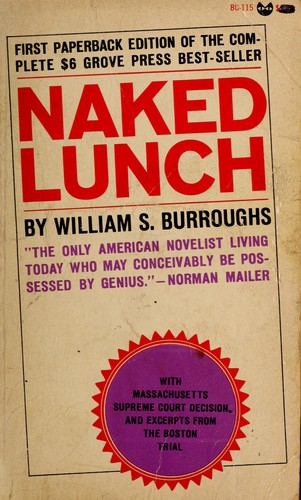
Assembled from drug-soaked fragments on a Tangier floor, published in Paris in 1959 and cleared of obscenity by a Massachusetts court in 1966, Burroughs’s novel is genuinely repellent to many readers and permanently changed what a novel could be.
It should be said at the outset that a great many intelligent readers cannot finish Naked Lunch, and that this is not a failure of nerve or literacy on their part. The book contains sustained depictions of sexual violence, degradation, torture and bodily horror, rendered without the modulation that normally signals authorial judgement. Readers who put it down are responding accurately to what is in front of them.
It is also, by common critical consent, one of the most consequential novels of the twentieth century — a book that dismantled assumptions about narrative continuity so thoroughly that everything from cyberpunk to punk lyrics to a substantial portion of postmodern fiction is working downstream of it. Both things are true and neither cancels the other.
Tangier, and Twenty-Three Routines
Burroughs settled in Tangier in late 1953, in the International Zone, and spent the years from roughly 1954 to 1958 producing an enormous quantity of material while deep in opiate addiction. The narrative portion of Naked Lunch consists of twenty-three routines — the term Burroughs used for his self-contained comic-grotesque set pieces — drawn from letters, sketches and an abandoned detective potboiler written across that period.
There was no manuscript in the ordinary sense. Ginsberg and Kerouac arrived in Tangier in early 1957 to help, and the retrieval operation has become part of the book’s legend for good reason. Paul Bowles recorded that Ginsberg came and began supervising the recovery of pages scattered across the floor of Burroughs’s room at the Villa Muniria, covered in grime, heel marks and mouse droppings. The result of their typing and ordering is the surviving Interzone manuscript, now at Columbia.
A Title from a Misreading
The title is an accident, and a perfect one. Ginsberg was reading material sent from Tangier aloud to Kerouac and stumbled over Burroughs’s erratic typing, saying naked lunch where the page read naked lust. Kerouac caught the misreading and immediately supplied a meaning for it.
The phrase came to stand for the book’s stated project: the frozen moment when everyone sees what is on the end of every fork. Burroughs’s subject is what addiction reveals about all other systems of control — the junk economy as the pure form of every market, in which the product is the consumer. That is the thesis the routines keep restaging, in progressively more grotesque costume.
Paris, Chicago, and the Long Fight to Print It
Maurice Girodias of Olympia Press initially rejected the book. He reconsidered after excerpts began appearing in literary journals — the Chicago Review, Big Table, and Yūgen, the magazine Hettie and LeRoi Jones were producing in New York. Olympia published it in Paris in July 1959 as The Naked Lunch in the Traveller’s Companion Series, with a dust jacket Burroughs designed himself.
Grove Press brought out the first American edition in 1962 (printed and bound in 1961). Editor Irving Rosenthal, assisted by Ginsberg, restored material from the Interzone manuscript that Olympia had omitted, so the American text differs from the Paris one. Barney Rosset held the release until he had won his obscenity case over Henry Miller’s Tropic of Cancer — a piece of strategic sequencing that says a good deal about how American publishing actually expanded its freedoms.
Boston, 1966
A Boston bookseller was arrested in January 1963 for selling the Grove edition. The resulting case was heard by the Massachusetts Supreme Judicial Court, which delayed its decision until after the U.S. Supreme Court ruled in Memoirs v. Massachusetts in March 1966. On July 7, 1966, the Massachusetts court held that Naked Lunch was not obscene.
It was the last major American literary obscenity trial, and it closed the sequence that Howl had opened in 1957. The decision was reprinted in the 1966 Evergreen paperback, which is a fair indication of how much the ruling had become part of the book’s identity. Norman Mailer and Allen Ginsberg were among those who testified to its literary merit.
The Text Nobody Can Fix
Scholars have never settled what the authoritative text of Naked Lunch is, and the reason is structural rather than archival. The book’s material accumulated over years in multiple locations with no controlling plan; the Paris and New York editions differ; substantial related material went into the books that followed, which Burroughs regarded as drawn from the same word hoard.
Grove issued Naked Lunch: The Restored Text in 2001, edited by James Grauerholz and Barry Miles, which is now the standard reading edition and appends Burroughs’s own related writings. Even that edition is a set of scholarly decisions rather than the recovery of a lost original, because no original was ever composed. This is a book whose instability is not damage. It is the specification.
What It Did to the Novel
Burroughs instructed that the book could be read in any order — the routines are not sequenced by causality, and the reader is invited to enter anywhere. This was a genuine structural proposal, not a gimmick, and it prefigured the formal cut-up method he developed with Brion Gysin immediately afterward in the Nova Trilogy of 1961 to 1964.
The influence is easier to trace than the book is to read. Its vocabulary of body horror, corporate control systems, viral language and drug-mediated perception runs directly into William Gibson and cyberpunk, into Ballard, into industrial and punk music, into Cronenberg’s 1991 film. Recommending it requires a caveat that most canonical novels do not: it is cruel, it is frequently disgusting, its treatment of women and of gay male sexuality is hard to read as anything other than contemptuous in places, and the reader who dislikes it is not missing the point. The point is largely what they dislike.
First published in Paris, July 1959, as The Naked Lunch in the Olympia Press Traveller’s Companion Series.
Columbia University Libraries, “Naked Lunch”: The First Fifty Years
Where to go next
Read it after Ginsberg’s Howl, whose 1957 acquittal made the 1966 verdict possible, and alongside Burroughs’s Junky for the same material told straight.
Previous: Ursula K. Le Guin, The Word for World Is Forest. Next: Anne Waldman, Fast Speaking Woman. One hundred books from the Beat Generation and the writers around them — the ones who got famous, the ones who got written out, and the ecological writing that grew out of the same soil. A new one every other day.
Sources
- “Naked Lunch”: The First Fifty Years — Columbia University Libraries
- Naked Lunch — Wikipedia
- The Naked Lunch by William Burroughs (1959) — Banned Books, Indiana University
- William S. Burroughs’ “Naked Lunch”: American Literature from Morocco — Qantara.de

CD Damitio writes at indignified.substack.com — essays on utopias, dystopias, and the spaces between. Free to read. No algorithm, no sponsored content. His books can be found on Amazon at https://www.amazon.com/stores/CD-Damitio/author/B001JP7NWA
CD Damitio writes INDIGNIFIED — utopias and dystopias explored. Free to read.