
The greatest adventurer of all time for me is the Moroccan vagabond, Ibn Battuta. He not only traveled everywhere in his known world, but he wrote about it in ways that no one before him had. Ibn Battuta’s journey lasted 29 years, so by Moroccan standards, my wife should be understanding of this current journey I’m on.
Ibn Battuta was the only world traveler in Middle Ages and he achieved fame because of he visited every Muslim ruler’s land of his time. He also traveled in China, Sri Lanka, Byzantium (which included huge amounts of Europe, Turkey, and Central Asia) and Russia. He traveled over 75,000 miles in his lifetime. And keep in mind most of this was by foot, camel, or horse. There were no frequent flyer programs then. He traveled like a nomad throughout the world and in the process, he introduced (and is still introducing) the cultures of the world to one another.
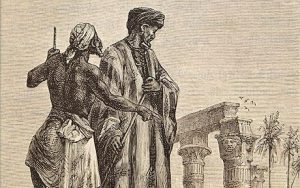
Ibn Battuta was a well known traveler who lived according to the slogan ‘never, if possible, cover any road a second time’. He traveled on camel, horse, by boat and on foot. He went as far as he could through every means of land transport. He also traveled to West Africa and visited Timbuktu, Niger, and Mali. He distinctly described the existing political, social and economic conditions, religious matters, and position of women in the nations and regions he visited.
Ibn Battuta Resources
The Adventures of Ibn Battuta
The Travels of Ibn Battuta in the Near East, Asia, and Africa
Traveling Man: The Journeys of Ibn Battuta
He was elected Chief judge of Delhi, and he spent his life as Qadi (chief judge) of Morocco in the city of Fes for twenty three years, meanwhile he also wrote of his travels which at the time included almost everything that was known about the world.
At the age of 21, Ibn Battuta started his travels from Morocco. The main reason for his journey was to go on the Hajj, the long journey to Mecca, like all other Muslims who are required to do the same during their lives if possible. 
He traveled for 29 years and covered almost 75,000 miles where he visited 44 modern countries. He faced many dangers and adventures on his way. Bandits attacked him and he nearly drowned in a sinking ship during his travels.
 Ibn Battuta was born in Morocco in a Muslim family in 1304. He studied Muslim law and in 1325 he left the place to make the journey to Mecca. He was very interested in adventure and world travel. Traveling to Mecca through land and by sea was dangerous. He traveled on land with a donkey at first. Later he joined a caravan with other travelers.
Ibn Battuta was asked to dictate the story of his travels to a scholar by the Sultan of Morocco. Today we are able to read that story in English and the story is called “Rihla-My Travels”.
THEY REFUSED TO STAY PUT. SO DID CD DAMITIO.
The person you just read about is one of them — the ones who chose the road over the roof, the horizon over the mortgage, the interesting life over the safe one. History is full of these people. Most of them never made the textbooks.
Vagabonds: Getting Lost Is the Point collects their stories — from Herodotus and Ibn Battuta to Jack Kerouac, Grandma Gatewood, and Anthony Bourdain. Sharp profiles, honest portraits, and the one thing they all share: a refusal to accept the default life on offer.
Written by CD Damitio — two VW buses, fifty countries, a decade outside America, and eventually Japan. He knows these people not as history but as kin.
The book ends with interviews with living vagabonds. And, in the final interview, with Planet Earth itself.
My books don’t fit in any neat box — because they’re about people who feel something huge is missing… and actually go look for it. Some even find it.
Dive into the full catalog and see which story hits you hardest. CD Damitio on Amazon.
More from Vagobond

CD Damitio writes at indignified.substack.com — essays on utopias, dystopias, and the spaces between. Free to read. No algorithm, no sponsored content. His books can be found on Amazon at https://www.amazon.com/stores/CD-Damitio/author/B001JP7NWA
CD Damitio writes INDIGNIFIED — utopias and dystopias explored. Free to read.